In the age of high-definition video calls, social media, and face-to-face networking, your smile is often the first thing people notice. It is your greeting, your sign of confidence, and a key part of your personal brand. Yet, for many Australians, smiling comes with a moment of hesitation. Whether it is a chipped tooth from a childhood sports injury, stubborn discolouration that whitening can’t fix, or gaps that have always bothered you, these imperfections can weigh on your self-esteem.
Enter the modern solution: dental veneers.
If you have found yourself searching for a veneers dentist near me recently, you are likely looking for more than just a dental procedure—you are looking for a transformation. In 2026, cosmetic dentistry has evolved from a celebrity luxury into an accessible, long-term investment for everyday adults.
This comprehensive guide will walk you through everything you need to know about the veneers process, from the initial consultation to the final reveal, helping you decide if this is the year you finally invest in yourself.
What Exactly Are Veneers?

Think of veneers as a “new skin” for your teeth. In technical terms, veneers teeth restorations are ultra-thin shells of ceramic (porcelain) or composite resin material, which are bonded to the front surface of your teeth.
Unlike a crown, which covers the entire tooth like a cap, a veneer only covers the visible front part. This makes them a more conservative option, preserving more of your natural tooth structure while delivering a complete aesthetic overhaul.
Veneers are the Swiss Army knife of cosmetic dentistry veneers. They don’t just solve one problem; they often solve three or four simultaneously. They can:
- Whiten teeth that are resistant to bleaching.
- Straighten the appearance of minor misalignments.
- Reshape small or worn-down teeth.
- Repair chips and cracks.
Is a Smile Makeover Right for You?
You might be wondering if you are a candidate. Generally, if your gums and teeth are healthy (no active decay or gum disease), you can be considered for veneers. They are particularly effective for patients dealing with the following issues:
1. Stubborn Discolouration
Standard teeth whitening works by lifting stains from the enamel. However, some deep stains—caused by medications like tetracycline, excessive fluoride use, or previous root canal treatments—are internal. Veneers simply cover these stains with a pristine, white surface that you select.
2. Chipped or Worn Edges
Teeth naturally wear down as we age. If you grind your teeth (bruxism) or have had minor accidents, your teeth might look flat or jagged. Veneers can restore the youthful length and shape of your teeth, often taking years off your facial appearance.
3. Gaps and Spacing (Diastema)
While braces or aligners are the standard for moving teeth, some adults prefer not to wait 12–18 months to close a small gap between their front teeth. Veneers can “close” these gaps instantly by widening the visible surface of the tooth.
4. Minor Misalignment
If your teeth are slightly crooked but you have a healthy bite, veneers are often referred to as “instant orthodontics.” They mask the rotation of the tooth, making the smile appear perfectly straight without moving the roots.
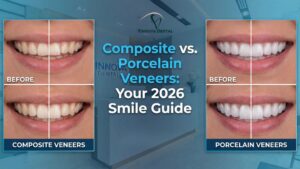
The Great Debate: Porcelain vs. Composite Veneers

One of the most critical decisions you will make during your consultation is choosing the material. This choice impacts the veneers cost, longevity, and final look.
Option A: Porcelain Veneers (The Premium Choice)
Porcelain veneers are the gold standard in cosmetic dentistry. They are custom-crafted in a dental laboratory by skilled ceramists.
- Aesthetics: Porcelain mimics the light-handling properties of natural enamel. It has translucency (allowing light to pass through slightly) and depth, making it indistinguishable from a real tooth.
- Durability: Porcelain is incredibly strong once bonded. It is also highly resistant to staining. You can drink coffee, tea, and red wine without worrying about your smile dulling.
- Lifespan: With proper care, they can last 10 to 15 years or longer.
- The Commitment: Because they require a tiny layer of enamel to be removed, the process is generally irreversible.
Option B: Composite Veneers (The Flexible Choice)
Composite veneers involve applying a tooth-coloured resin directly to the tooth surface, which the dentist sculpts and cures with a special light.
- Aesthetics: Modern composites are excellent, though they can sometimes look slightly more opaque (solid) than porcelain.
- Speed: This is often a “same-day” procedure. You walk in with your old smile and walk out with a new one.
- Reversibility: Often, little to no enamel needs to be removed, making this a more reversible option.
- Maintenance: Composite is more porous than porcelain, meaning it can stain over time and may need polishing every year or two. They typically last 5 to 7 years.
The Step-by-Step Veneers Process

Understanding the journey can help alleviate anxiety. Here is what typically happens when you visit a specialist like Vinnova Dental for cosmetic dentistry veneers.
Step 1: The Consultation & Smile Design
This is the “blueprint” phase. You will discuss your goals. Do you want a Hollywood white smile, or a natural, subtle improvement? Your dentist will examine your oral health and may use Digital Smile Design (DSD) technology to show you a digital preview of your potential result.
Step 2: Preparation (The “Prep” Visit)
If you are getting porcelain veneers, the dentist needs to create room for them so they don’t look bulky.
- A very thin layer of enamel (about 0.3mm to 0.5mm) is gently removed from the front of the teeth.
- High-precision impressions or 3D scans are taken and sent to the dental lab.
- Temporary Veneers: You won’t walk around with prepared teeth! Temporary veneers are placed to protect your teeth and let you “test drive” the new shape while the permanent ones are being made.
Step 3: The Lab Phase
Over the next 1–2 weeks, master ceramists hand-craft your veneers. They layer ceramic powders to create the perfect shade, translucency, and texture that matches the rest of your natural teeth.
Step 4: The Bonding (The Reveal)
This is the exciting part.
- The temporary veneers are removed.
- The dentist places the permanent veneers on your teeth with a temporary paste to check the fit and colour. You get to look in the mirror and give the final thumbs up.
- Once approved, the teeth are cleaned, and the veneers are permanently bonded using high-strength dental cement.
- A final polish ensures they feel smooth and natural against your tongue.
Veneers Cost: Understanding the Investment
Let’s address the elephant in the room: veneers cost. In Australia, cosmetic dentistry is an investment, but it is important to understand what you are paying for.
Cheap veneers often lead to disappointment—bulky teeth, inflammation of the gums, or veneers that pop off. When you pay for quality, you are paying for:
- The Skill: An experienced cosmetic dentist understands facial symmetry and occlusion (your bite).
- The Material: High-grade medical porcelain vs. cheap imports.
- The Lab: Australian dental labs are world-renowned for quality. Outsourcing to cheaper overseas labs can result in poor fit and aesthetics.
While composite veneers are more budget-friendly upfront, porcelain veneers offer better long-term value because they do not need to be replaced or repaired as often. Many clinics, including ours, offer payment plans to help manage the cost over time.
Veneers Before and After: Setting Expectations
One of the most useful things you can do is look at veneers before and after galleries. However, do not just look for the “whitest” teeth. Look for:
- Texture: Do the teeth look like plastic, or do they have natural ridges and light reflection?
- Gum Health: In the “after” photos, are the gums pink and healthy, or do they look red and irritated? Healthy gums are a sign of a well-fitted veneer.
- Face Shape: A good dentist matches the shape of the tooth to the shape of the face. For example, rounder teeth can soften a square jawline, while square teeth can add definition to a round face.
Life With Veneers: Maintenance and Care

A common myth is that veneers are indestructible. While they are strong, they still require care.
- Hygiene: You cannot get cavities in the veneer, but you can get cavities under them. You must brush and floss daily to protect the supporting tooth structure.
- Diet: Porcelain is stain-resistant, but if you have composite veneers, try to minimize black coffee, turmeric, and red wine, or rinse with water afterwards.
- Habits: Do not use your teeth as tools! Opening packages or biting your nails can chip a veneer just as it would a natural tooth.
- Night Guards: If you have a history of grinding your teeth, your dentist will likely prescribe a protective night splint to wear while sleeping. This protects your investment from excessive force.
Why Choose a Local Australian Dentist?
With the rise of “dental tourism,” some patients are tempted to fly overseas for cheaper treatment. However, veneers are a precise medical procedure, not a product you buy off the shelf.
- Follow-up: Adjusting your bite after the numbing wears off is common. This is easy with a veneers dentist near me, but impossible if your dentist is in another country.
- Regulations: Australian infection control and material standards are among the strictest in the world.
- Longevity: If a veneer chips or de-bonds in 5 years, you need a local dentist who knows your history and has your records to fix it.
Frequently Asked Questions (FAQs)
Does getting veneers hurt?
Modern dentistry is very comfortable. The preparation phase is done under local anaesthesia (numbing), so you shouldn’t feel pain. After the numbing wears off, you might feel some sensitivity to hot and cold for a few days, but this usually settles quickly.
Can I just get 2 or 4 veneers?
Yes, you can. However, most cosmetic dentists recommend treating the “social six” (the front six teeth) or usually 8-10 teeth for a full smile makeover. Treating only 2 front teeth makes colour matching extremely difficult, as your natural teeth will fade/stain differently to the veneers over time.
What happens if a veneer falls off?
While rare with modern bonding, it can happen. If you have chosen a reputable local dentist, you simply save the veneer and come in for an appointment. Often, it can be re-bonded. If it is broken, a new one can be made quickly.
Do veneers look fake?
They only look fake if they are designed poorly. The “fake” look usually comes from choosing a shade that is too opaque and white (often called “Toilet Bowl White”) and teeth that are all the exact same length. A skilled dentist adds subtle imperfections and translucency to ensure they look real.
Conclusion: Is 2026 Your Year?
Deciding to get veneers is a personal journey. It is about more than just teeth; it is about the freedom to laugh without covering your mouth, the confidence to speak up in meetings, and the joy of seeing a photo of yourself that you actually love.
If you are tired of hiding your smile, the technology and artistry available today make this the perfect time to explore your options. You don’t have to commit to surgery immediately—start with a conversation.
Take the First Step Toward Your Dream Smile
At Vinnova Dental, we combine artistry with advanced dental technology to create smiles that look and feel natural. We invite you to sit down with us, discuss your goals, and see exactly what is possible for you.
Don’t wait another year to love your smile. Call our friendly team on (03) 5721 3090 or book online below.